This site uses cookies.
Some of them are essentials while other help us improve your experience. Read Our Privacy Policy
July 16, 2026
Mastering Push and Pull: The New Youth Sports Media Model
by Adam Hanft, Global Branding Expert, Strategic Advisor to Pixellot
Anyone who has kids knows how fast they grow up.
The same phenomenon is happening with the games the kids play.
Youth sports are growing up, and it’s happening with dazzling speed. I’ve used this platform to keep making the point that it is a $40B category. To put that in perspective, ice cream is only about a $15B category; energy drinks are about $25B. Together they are about the size of youth sports.
That’s crazy.
This onrushing maturity is changing the industry’s fundamental structure, as youth sports transforms into a media business. And the reality is that For those who participate in the ecosystem, and have helped build in, media is a new and different world.
The building blocks of youth sports have been fundamentals like cameras, automated production, registration systems, scheduling, coaching and so on. Even though there is a massive amount of content generated – at Pixellot we stream over 150,000 games every month – the industry hasn’t viewed itself through the lens of a media business.
Now is the time to start.
Two simple but powerful forms of media exist.
Those of you who have been watching the transformation of media for a while – like I have – will recognize that today’s landscape is unrecognizable from what was once a world of three networks. The morphed into cable.
Today it’s a media cacophony, with on-demand, streaming, linear TV, freemium models and more. A crowded and ever-changing reality.
Here’s a framework for organizing the cacophony. It’s a more durable way to think about the industry, and one that is useful to youth sports. As I will demonstrate, every media experience is either push or pull.
Push Media: A World of Passive Viewing.
Push media presents you with a finished experience. What you see is what you get, and all you see is all you get.
Someone else decides everything in advance, someone else makes all the editorial judgements: the concept, the narrative structure, the production – from beginning to end. Whether there are three television networks or three million titles on Netflix, the essential contract is the same. Once you press play, you surrender yourself to someone else’s editorial judgment. You may choose which movie to watch, but you don’t choose how it unfolds.
Yes, you can rewind. But you could have done that with a VHS cassette three decades ago.
Pull Media: Where the Viewer is Participant.
In the dynamic world of pull media, the relationship gets re-set.
Take Spotify, They were one of the first to understand and amplify the power of the pull model at scale. Spotify didn’t simply give listeners millions of songs. They were invited to become programmers, and as a result the playlist became more important than the album, it was a living artifact of self-expression.
People began organizing music around workouts, dinner parties running and road trips. Even around heartbreak.
When you see the world this way, examples of “pull power.” Google Maps doesn’t exist in full, it lives in the components that users assemble from it. The same for Redditt and the Bloomberg terminal; what makes them valuable is how the users pull data from them.
On a macro cultural level, this shift is everywhere. We search. We clip. We save. We share. We assemble our own experiences from sources that would have been unimaginable twenty years ago.
The future belongs to companies that understand when people want to lean back have content pushed at them, and when they want to lean in and help themselves.
Youth Sports is About to Media-ize Itself.
For decades, youth sports media barely existed. If you missed the game, you were out of luck.
To preserve those moments, parents pointed camcorders from the sidelines. Grandparents waited for grainy highlights. Coaches scribbled notes from memory. That’s push media, and it was made possible because hardware and AI have solved the capture problem.
The next challenge is solving the experience problem.
Because the full game is one way to consume the experience. And it might not be the fixed experience most people want. Ask even the most crazily-obsessed, helicopter sports parents out there if they watch the entire basketball game, and a guilty look will take possession of their face.
They don’t want the entirety of the game pushed at them They want to be able to pull what is most important to them. And that is what Pixellot is innovating, and world where AI changes
not just production, but creates a new grammar of sports media.
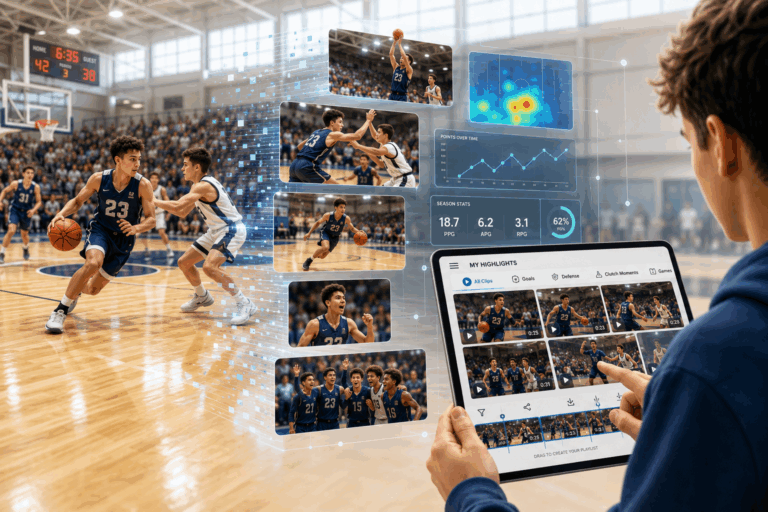
Imagine opening an app and pulling the content you want to view, in the same way that you extract the relevant coordinates from Google maps.
Show me every goal from Emma’s season, her personal stats, an timeline of development.
Show me every successful press against Jason’s rival.
Show me every possession if Drew’s that lasted more than thirty seconds.
String every clutch moment from tournament play, in a personalized highlight reel.
The game stops being something you watch.
It becomes something you explore; this doesn’t replace traditional viewing experience. It reinvents and expands it.
And within this new experience, the monetization opportunities for everyone in the youth sports ecosystem are profound. Advertising can generate revenue for leagues, federations, schools and other stakeholder who are woefully under-funded.
And revenue can be generated while stillsrespecting the honor and integrity of youth sports; I wrote about this and provided some guardrails for “soft monetization” in a previous blog.
Pixellot Will Lead the Push and Pull Futures.
At Pixellot, we’ve spent years making it possible for organizations to capture every game automatically.
But AI now gives us the power to create a far more compelling future; nothing less than a searchable – and infinitely malleable -–library of moments. So every viewer can experience the same game differently. Gaining the ability to construct their own experiences while never losing access to the complete game when they want it.
That goes beyond the cliché of personalization to invent a new form of editorial sovereignty.
The winners in sports media will build platforms that our desire to sit back and let a story unfold.
And our equally powerful desire to reach into that story, rearrange it, interrogate it and make it our own.
The next generation of sports media won’t choose between push and pull.
It will master both.